
A tribute to the human potential for peace
Published:Sunday | January 27, 2013 | 12:00 AM
Laura Tanna, Contributor
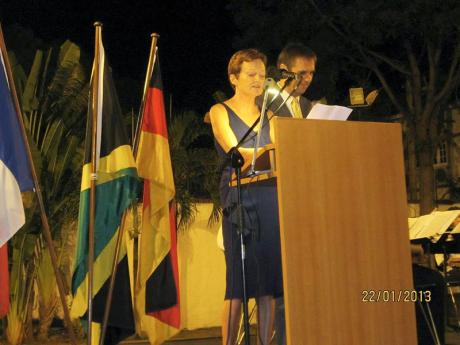
I'd never heard of the Elysée Treaty and certainly had no intention of writing about it until French Ambassador Ginette de Matha took the microphone and spoke about her childhood in France after the war with Germany. Tears came to my eyes as she made vivid the incredible measures taken by wise people to heal the wounds of a devastating time for both countries. She recalled:
"I still remember the day my parents informed me that I would learn German as first foreign language. I was 10, just enrolled at secondary school. I was born in the southwest of France, a part of the country which hosted during the Second World War refugees from Alsace and Lorraine, in which groups of maquisards (resistance fighters) were active. My father was among them; my grandfather had been injured in Verdun during the first World War.
"Precisely for those reasons, because war had seriously affected their youth, they wanted a long lasting peace for the rest of their lives and, above all, for the young generations. The treaty came at the right time."
At a ceremony held to celebrate the 50th anniversary of the signing of the Elysée Treaty, Ambassador of the Federal Republic of Germany to Jamaica, H.E. Josef Beck, had started the proceedings by explaining to those gathered the significance of the Elysée Treaty:
"For centuries, our two countries were rivals, adversaries, even 'hereditary enemies'. Their relationship went through its most tragic period during the two world wars, particularly with the crimes committed by the Nazi dictatorship. We must be aware of this historical dimension in order to get an idea of the courage and audacity shown by Konrad Adenauer and Charles de Gaulle in signing the Elysée Treaty on 22 January 1963.
"The text of the treaty is short and compact, but its content is almost revolutionary: in it, Germany and France commit themselves to nothing more and nothing less than 'arriving, insofar as possible, at a similar position' on all the important economic, political and cultural issues. Fifty years on, the treaty is still just as relevant. The key themes of its preamble - reconciliation, young people, solidarity and Europe - embody the essence of our partnership. Over the years - beyond the vicissitudes of everyday life - it has enabled us to create a closeness and friendship that few peoples share. Centuries-old enmity can give way to profound friendship: this is the message of the Elysée Treaty, which is of universal significance."
Remembering how many millions of people died during World War II, and the physical devastation of Europe and yet what a remarkable recovery has been made, I kept thinking if only the Peoples National Party and the Jamaica Labour Party were to agree on such a treaty and take the same steps towards reconciliation in Jamaica. Couldn't the same economic growth and peace be built here in one generation? This Elysée Treaty laid the foundation for what has become the European Union and it started by building bridges with the first generation after the end of the Second World War. Ambassador de Matha continued her personal message saying:
"I still remember the first trip of 30 schoolboys and girls of my city, Périgueux, France to Amberg, Germany, in 1964. We were hosted by families while attending courses together with our 'correspondants'. It helped a lot to improve our language skills. But, above all, we discovered new habits, food, humor. Shy, candid, enthusiastic and without prejudice like young can be, we shared the daily life of our new friends. And the German correspondants did the same the year after. At that time, the ink of the treaty was still fresh."
She then turned to the German Ambassador and said: "Years after, as a student, Josef, you went to Nice, France, and myself to Frankfurt, Germany. So it worked. The treaty took concrete effects in the daily life of so many German and French citizens. Every year, 200,000 young people participate in school and college exchanges between our two countries. Indeed, eight million since 1963. Today, there are more than 2,000 twinnings between German and French towns and cities, which decisively help boost our social and cultural exchanges ... . Education and culture have been the engine of the friendship, in addition to the high-level dialogue and cooperation enshrined in the treaty itself."
In an incredibly gracious gesture, to highlight the importance of education and culture, the joint French/German event featured a concert "Celebrating French and German Music" performed by the String Chamber Ensemble conducted by Steven Woodham, and at the end each and every musician, many of whom were students, was individually introduced and applauded, with special note being taken of the two violin soloists, Sydnae Taylor and Amy Hussey. The Jamaican Master of Ceremonies, Devon Yetman, speaking in both French and German, managed the proceedings with great elan. Earlier Steven Woodham told us of his recent travels in China and the thrill of visiting the Shanghai Conservatory - surely the Chinese Embassy or our own Foreign Affairs will want to tell us more about such an exciting venture.
Finally, guests were invited to examine the large posters and photographs depicting the actual events surrounding the signing of the Elysée Treaty 50 years before. Is it too much to hope that this exhibition will be on view at the Jamaica Library Service or some other location for our own citizens, especially our youth, to learn how important it is in the words of Ambassador de Matha "to stay open, to dialogue, to accept differences and in the meantime, to try to find a common way of life in sharing the same values of mutual respect ?"
Certainly, Ambassadors Josef Beck and Ginette de Matha, as joint hosts, demonstrated that art and education can be combined in a truly moving way which could serve as an inspiration to all of us in Jamaica.