
Liberty Hall: The Legacy of Marcus Garvey - Sankofa 2014
Published:Sunday | April 27, 2014 | 12:00 AM

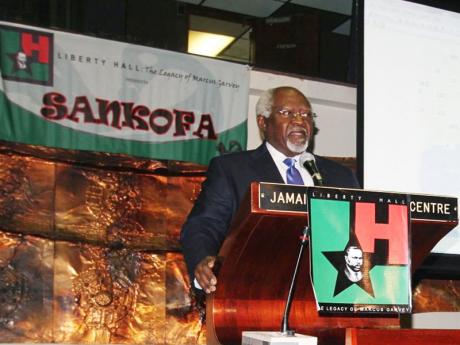
The name 'Sankofa' is taken from a well-known Adinkra symbol from Ghana, which features a bird looking backwards. Sankofa articulates the need to look to the past in order to take lessons for the present and future.
This year marks the 100th anniversary of the Universal Negro Improvement Association and African Communities League (UNIA-ACL). As its first act of commemoration, Liberty Hall: The Legacy of Marcus Garvey hosted its eighth successful all-day educational symposium titled 'Sankofa' for more than 300 student teachers from colleges and universities islandwide, and those enrolled in Medgar Evers College, New York.
The theme for this year's event was 'Building Self-Identity and Self-Reliance among People of African Descent through the Activities and Enterprises of Garvey's UNIA-ACL (Lessons for Teachers in the Twenty-First Century)'.
Two fundamental tenets of Garveyism that were highlighted in the theme this year are race consciousness and economic nationalism. Race consciousness is the starting point of Garveyism. Marcus Garvey posited self-acknowledgement and self-assurance as a prerequisite to racial unity. Slavery and colonialism had the effect of not only physical domination, but also the perpetration of negative self-image among black people. Garvey spoke about the need to get rid of this negative self-image, which exists deep within the black psyche. Supporting this aim was Garvey's constant promotion of black beauty, capability, and intelligence, and of the primacy of Africa as the birthplace of civilisation.
Economic empowerment
Marcus Garvey also had economic empowerment as one of his aims towards the redemption of the black race. Owning the means of production, and not simply providing labour, was critical to black empowerment.
At the heart of this economic scheme was also the formation of transnational economic linkages and of resource sharing within the race. Hence, there was the formation of a number of economic projects such as the Black Star Line, The Negro Factories Incorporated, the Negro World, The Black Man, New Jamaican newspaper companies, the Edelweiss Amusement Company, and other ventures. These economic projects furthered the tenet of race consciousness and served not only as financial enterprises, but also as channels through which the guiding philosophies of Garveyism were perpetuated. For instance, the newspaper companies served as ideological enforcers.
One of the mechanisms employed by people of African heritage to ensure their survival in the face of monumental oppression of the systems of slavery, genocide, discrimination, and lynching was their memory of African cultural systems. These are reflected in our dance, music, internal marketing systems, hair-braiding techniques, and many more.
Teachers of children of African origin in the 21st century have a responsibility to be better informed by seeking out for themselves books and articles that challenge accepted myths about Africa and the history of the African diaspora, in order to provide a more truthful and inspiring representation to their students. In doing so, we will challenge our children to achieve greatness beyond their expectations.
Sankofa was conceived in 2005 as a programme to cater to students pursuing history and Caribbean studies in preparation for the Caribbean Secondary Education Certificate and Caribbean Advanced Proficiency Examinations. Students of colleges and universities (including teacher's colleges) also benefit from the exhibitions and films related to Caribbean and African history, which form part of the experience.
This year's event was supported by Dr Julius Garvey, son of Marcus Garvey; the Institute of Jamaica; Friends of Liberty Hall, and the Spanish Court Hotel.