
The story of Zong
Published:Sunday | December 22, 2019 | 12:00 AM
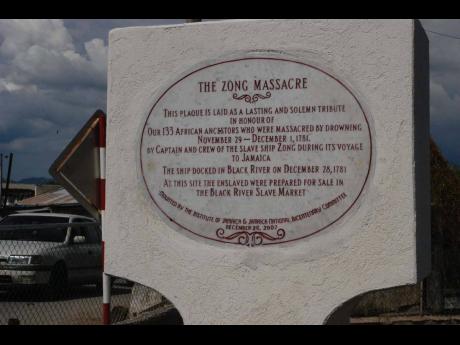
December 22 should be cemented into the consciousness of all Jamaicans. On that day in 1781, the slave ship Zong arrived in Black River with just over half of the enslaved Africans who were forcefully put on the ship in Ghana, and 122 of them had deliberately drowned.
This is a short history of that voyage.
In 1781, a Liverpool syndicate led by one of the city’s major traders in enslaved Africans, William Gregson, on a slaving voyage to Cape Coast and Anamabu, bought an impounded ship previously owned by the Dutch and called Zorgue (ironically meaning “care” in Dutch). There were already 244 enslaved Africans on board, and they became part of the transaction.
More slaves were bought in the area of Cape Coast and Accra and placed on board during the five months before the ship sailed and under the captaincy of the inexperienced Luke Collingwood, previously the surgeon on The William, and a hastily assembled crew, the ship, now renamed Zong, set off on its journey to Jamaica on August 18, 1781. Before the Atlantic crossing, it made a stop in Sao Tome, leaving there on September 6, 1781. On board the ship destined for Black River in Jamaica, some 4,000 miles away, were 440 enslaved people, 19 crew members (including the first mate James Kelsall, and second mate, Joseph Wood) and a passenger, Robert Stubbs, a former slaver captain, who would later have to captain the ship temporarily when Collingwood fell ill.
Like most slavers, Zong took on too many people for the size of the ship, which was only 110 tons and which should have on board no more than 200 people. Its journey was slow, having sailed from further south than most slavers.
After about 10 weeks after leaving Sao Tome, it arrived in Tobago, after which it continued on its journey to Black River – a total journey of 100 weeks, including lost time when it veered off course near Haiti before it got back on course for Jamaica. By then, complaints of water shortage, illness, and death among the crew and poor navigational and leadership decisions all created a level of confusion aboard.
Added to this, towards the end of November, many of those on board – around 62 – had started to die from disease and malnutrition. There were already 244 people on board when the ship was resold had endured an inordinately long period in the hold; and no one knows how long before that they had on board. With the captain and crew arguing that water and rations would not last for everyone on board before arrival in Jamaica, the decision was taken to jettison some Africans in order to avoid more deaths and threaten the profitability of the journey and the possibility of claiming insurance for “lost cargo”.
Thrown overboard
At 8 p.m. on November, 29 1781, 54 people, mainly women and children, were dragged from below deck, unshackled, and heaved from the ship through the cabin window, singly, into the ocean. Two days later, on December 1, 42 men were thrown overboard, handcuffed and in irons, from the quarterdeck. A third batch of eight were murdered later. Many struggled, and the crew had to tie iron balls to their ankles to drown them. Another 10 Africans threw themselves overboard in what has been described as an “act of defiance.” One man was said to have scrambled back on board to plead with the crew to stop the killings, but his pleas obviously fell on deaf ears. More Africans (around 36) were to die before the ship reached Jamaica.
Tragically, when the Zong arrived in Jamaica on December 22, 1781, only 208 out of the 440 Africans had survived the voyage. A newspaper reported on January 9, 1782, that 200 of the survivors were soon advertised for sale.
That was not the end of the case of the Zong. James Gregson, the ship’s owner, filed an insurance claim for their loss. The insurance initially taken out on the ship included £8,000 for the captives alone, at around £30 sterling per enslaved African. The insurers refused to honour the claim, and the owners took them to court. The initial case was heard in Guildhall in March 1782, where Gregson argued that the Zong had not had enough water to sustain both crew and the enslaved, and, therefore, the decision to jettison some of the “cargo”. The insurance underwriter, Thomas Gilbert, in disputing the claim, argued that the Zong had 420 gallons of water aboard when she was inventoried in Jamaica.
Legally bound
Despite this, the jury in 1782 (under the direction of William Murray, the Earl of Mansfield and the Lord Chief Justice of the King’s Bench found in favour of the owners, stating that the insurers were legally bound to pay compensation to the Gregson Syndicate for the loss of the 132 Africans. The ruling caused an intensification of the anti-slavery activism in the UK, especially after abolitionists like Granville Sharp (who called it a massacre), and Olaudah Equiano publicised the case and brought people like Thomas Clarkson, the Reverend John Ramsay, and William Wilberforce into the campaign.
The insurers appealed the case in 1783, with Lord Mansfield himself presiding in the highest court in Britain on May 21-22 of that year, flanked by Mr Justice Buller and Mr Justice Willes. Among those who testified was Great Britain’s Solicitor General, Justice John Lee, who claimed that property, not people, had been thrown overboard the Zong. He is reported to have said: “What is this claim that human people have thrown overboard? This is a case of chattels or goods. Blacks are goods and property. It is madness to accuse these well-serving honourable men of murder … The case is the same as if wood had been thrown overboard.”
These sentiments, expressed by such a high official, incensed many people, and, in the process, provoked a great deal of public interest. Nevertheless, at the end of the review of the evidence and the legal documents about the Zong case, and especially because at this trial it was revealed for the first time that the last batch of Africans were thrown overboard a day after a shower of rain relived the water shortage, no compensation was given to the owners. A retrial was ordered by Mansfield and his colleagues, but because there was no evidence that it took place, nothing came of it.
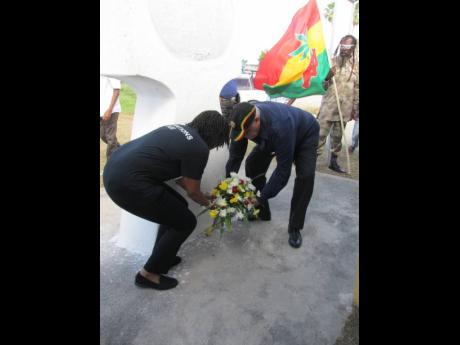
A monument now stands to memorialise the 132 victims of the Zong Massacre in Black River, St Elizabeth.