
Elizabeth Morgan | Summit for a new Global Financial Pact
Published:Wednesday | June 28, 2023 | 12:20 AM
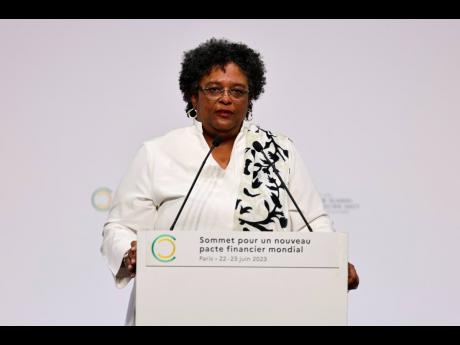
The Summit for a new Global Financial Pact was held in Paris, France, from June 22-23, aimed at achieving consensus on reforming the international financial system in the interest of developing countries in the fight against climate change, debt and poverty.
It was co-hosted by President Emmanuel Macron of France and Prime Minister Mia Mottley of Barbados. It is reported that 40 heads of state and government attend with only two represented from the G7, France and Germany.
From the BRICS countries, President Lula Da Silva of Brazil and South Africa’s President Cyril Ramaphosa were present. China was represented by Prime Minister Li Qiang and India by Finance Minister Nirmala Sitharaman. The USA was represented by Janet Yellen, Secretary of the Treasury; and Climate Envoy John Kerry. Ursula Gertrud von der Leyen, president of the European Commission, represented the union.
For the Caribbean Community (CARICOM), Prime Minister of St Vincent and the Grenadines, Dr Ralph Gonsalves, attended. Guyana was represented by the Senior Minister at the Office of the President with responsibility for Finance, Hon Ashni Singh.
French President Emmanuel Macron, in his opening remarks, stated that “No country should have to choose between reducing poverty and protecting the planet”. He called for a substantial increase in public and private funding to tackle rising inequality in the world.
President Macron has been associating himself with issues of importance to developing countries, recognising the need, I hope, for global engagement in difficult and uncertain times.
Prime Minister Mia Mottley’s Bridgetown Initiative launched at the COP27 climate conference provided the foundation for this summit to reflect on the need to reform the international financial system (Bretton Woods) to address the modern issues affecting developing countries impacted by climate change, the COVID-19 pandemic, the war in Ukraine, and increasing debt. Prime Minister Mottley has focused on the particular situation of vulnerable Small Island Developing States (SIDS), which include CARICOM member states.
The Bretton Woods Agreement created multilateral financial institutions, the World Bank and the International Monetary Fund (IMF), at the end of World War II, when many developing countries were still colonies. The heads of both the World Bank, Ajay Banga; and IMF, Kristalina Georgieva, attended this Paris Summit.
The UN Secretary General António Guterres, in his opening remarks, called for “a new Bretton Woods moment – a moment for governments to come together, re-examine and reconfigure the global financial architecture for the 21st century”.
Prime Minister Mottley, in her opening remarks, stated that what is now required is transformation and not reform.
SUMMIT ACHIEVEMENTS
Some news reports point to the absence of major developed countries, being of the view that meaningful discussions required their presence. Anyone who has followed discussions in the UN related to reform of organs and institutions will tell you that this will not be an easy discussion and transformation will not arrive in the short term. Like the New International Economic Order discussions of the 1970s, it challenges the existing system and the post-war power structure.
However, with the BRICS, to this point, threatening to establish a rival system and France and Germany showing interest, it might be possible to make some headway. With two storms in June in the Caribbean, spring fires in Canada, long-term droughts and heatwaves, the reality of climate change is being forcefully demonstrated and needs urgent attention.
Some have seen this Paris conference as a start to the modern conversation on changing the financial system and as a step in the right direction.
It is reported that there is an outcome statement from this summit, but I was not able to find it.
Two main outcomes reported are that:
1. Developed countries, this year, will achieve the target, which should have been met in 2020, of transferring US$100 billion of their IMF Special Drawing Rights to developing countries for climate change. They also promised a future US$200 billion in 10 years.
2. A climate resilient debt clause was agreed which will allow a pause in debt repayments for new multilateral loans in the aftermath of natural disasters. This was a proposal by Barbados for vulnerable countries.
Assessment of whether progress was made at this Paris Summit towards reform or transformation and cooperation on climate change and development will be more possible from the proceedings of upcoming conferences, such as the EU-CELAC Summit, Brussels, July 17-18; the BRICS Forum Summit in South Africa, August 22-24, which President Macron is expected to attend; the G20 Summit, New Delhi, India, September 8-10; the UN Sustainable Development Goals (SDGs) Summit, New York, September 18-19; and COP 28, Dubai, November 30-December 12.
Elizabeth Morgan is a specialist in international trade policy and international politics. Email feedback to columns@gleanerjm.com